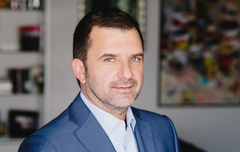
The leader of the "Yashar" party, Gadi Eisenkot, is a former general who served as chief of the Israeli army from 2015 to 2019.
He is credited with publicly formulating the "Dahiyeh Doctrine" in 2008, which involves the use of "disproportionate force" and large-scale destruction of civilian infrastructure against groups such as Hezbollah and Hamas.
The 66-year-old entered politics in 2022, joining former Defense Minister Benny Gantz's "National Unity" alliance, and later became part of the war cabinet formed by Netanyahu after the October 7 attacks.
His son, Gal (25), and a nephew were killed in December 2023, while another nephew died in November 2024, while participating in the war in Gaza. According to commentators, these losses have helped to create a connection with the electorate, which sees itself as wounded by the war.
In June 2024, he left the war cabinet along with Gantz, accusing Netanyahu of not having a strategy to end the war. A year later, Eisenkot founded the "Yashar" party, advocating the idea of a professional government, compulsory military service for all – including ultra-Orthodox Jews – as well as the creation of a state investigative commission to examine the failures that occurred before October 7.
Who can form the new government?
Exit polls show that neither Prime Minister Benjamin Netanyahu nor his main rival, Gadi Eisenkot, have a clear path to securing a governing majority. As a result, the options for post-election coalition formation remain wide open. A political stalemate, a minority government, a unity government or even new elections are all possible scenarios.
The news is bad for Netanyahu. His bloc, made up of ultra-Orthodox and far-right allies, has lost its majority, falling from 68 to just 50 seats in parliament. According to polls, his party, "Likud", is expected to secure a significant number of 25 seats, thus remaining the largest political force. However, this result is still far from the majority of 61 seats needed in the 120-seat parliament. To stay in power, Netanyahu absolutely needs a coalition.
The opposition bloc holds, on paper, a sizeable 70 seats, but in reality it is divided and divided, making it difficult to find a way forward. The Jewish Zionist parties have 52 seats, while the Arab parties are projected to win a record 18 seats, the highest ever representation of Arabs.
Eisenkot's "Yashar" party is expected to be the largest force in the opposition bloc with 22 seats, but leaders of other parties in this bloc have ruled out the possibility of a government that relies on Arab votes, which significantly complicates any effort to remove Netanyahu from power.
The record turnout of Arab voters appears to be one of the key developments of these elections. Palestinian citizens of Israel – who make up about 20% of the country’s population – have traditionally had a lower turnout than the national average. In the 2022 elections, Arab turnout was 53%. This time, it appears to have increased significantly, exceeding 78%. This is seen as a protest vote against Netanyahu’s government and his far-right allies: National Security Minister Itamar Ben Gvir and Finance Minister Bezalel Smotrich.
Meanwhile, high voter turnout raises the bar for smaller parties, as they will need more votes to pass the 3.25% electoral threshold. Polls are only projections; the situation could change as the actual votes are counted overnight. ©LAPSI.al