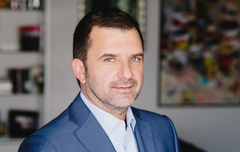
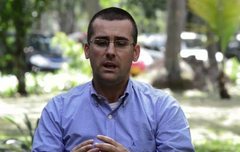
Erjon Vishkulli, the 28-year-old who lost his eye to a rubber bullet fired by police during the October 24 protest, is in Rome's Gemelli hospital, receiving specialized treatment. And while Prime Minister Edi Rama boasts that he personally arranged for his transport to Italy, he has cynically confirmed one of the reasons that have brought young people like Erjon to the protests: the lack of health services and the difficulties in securing the necessary treatment in Albania.
Meanwhile, the Tirana Prosecutor's Office registered this Monday the first criminal proceeding for police violence since the start of the student protests on October 13. The investigation into the injury of Vishkull was launched for abuse of office and committing arbitrary acts. Prosecutors administered the footage of the Bank of Albania cameras to identify the officer who shot the 28-year-old, while a letter of request is being prepared for the Italian authorities, where the rubber bullet from the injured man's eye is expected to be sent. About 20 medical records of other injured protesters are also included in the investigation.

But identifying and punishing the police officer who pulled the trigger is only part of the responsibility. The same must be said for officers who have hit neutralised citizens or used disproportionate force. It remains to be seen whether the investigation will stop at the direct perpetrators, or will move up the chain of command that led the police interventions.
The problems within the police seem to have been understood even by its leaders. A letter classified as “Extremely Urgent”, signed by the Deputy Director for Public Security, Edmond Meshini, was distributed to the seven police stations in Tirana and the Kruja Police Station a few days ago. The document requires the identification of officers and vehicles involved, the preservation of camera footage in the escort and interview areas, and the respect of legal guarantees for minors. The instructions for documenting interventions and the treatment of detainees take on particular importance after reports of violence, unidentified police officers and violations of the rights of protesters.
In a complaint to SPAK, the Res Publica Center and other organizations requested the investigation of over 180 suspected illegal episodes, to determine whether they were individual actions or an organized practice, ordered or tolerated by leaders.

But responsibility cannot be considered in isolation from the political climate that accompanied the interventions. Police violence escalated after Prime Minister Rama's meeting with police leaders, where he gave a message that encouraged pressure and brutality towards protesters: "Anyone who is in a violent demonstration is a target of the state police," adding that even a protester who does not use violence is "just as much a target for the police as anyone else."
Rama's logic contradicts the principle that the use of force must be necessary, proportionate and related to the specific behavior of the individual. Presence at a protest does not automatically make a citizen a legitimate object of police violence.
But while speaking to the police officers he would later bring out on the streets, Rama hardened his language, portraying the protesters as enemies of the country. He described them as manipulated by ANTIFA, Russia and Iran, while promising the police officers 2,500 euros each for their resistance in what he called a “front.” “I am with you until the end,” Rama told the police officers at the meeting, lending political support to an institution that was facing increasing allegations of violence while the media had already documented the ongoing terror at the protests.

The Prime Minister was not the one who whispered the order to injure Vishkulli, but his responsibility for the escalation of police violence is direct, as direct as the behavior of the police with the messages given by the top of power and the behavior they encourage. When protesters are presented as foreign enemies, Russian or Iranian, while the police are presented as a force protecting the government from their threat, the line between law enforcement and political repression becomes increasingly gray.
Therefore, until the investigation is sufficient to identify the police officer who shot Vishkulli, but fails to clarify the orders, command responsibilities and possible tolerance of violence, it will remain incomplete. The police officer who pulled the trigger can be found today in a police station, but responsibility for the climate that turned the protester into a target must be sought in the Prime Minister's office./Lapsi.al